Posts

On Pruning and Classifying Trees

Image
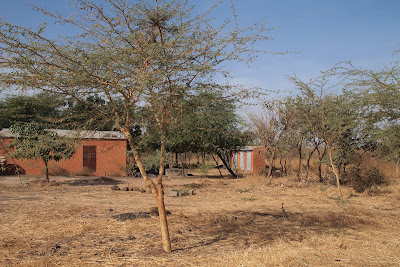
I have spent another wonderful week in Sandiara with Beersheba Project. The name of this 250-acre (100 hectare) plot of land on which I am working finds its source in the Biblical account in Genesis 21 where Abraham plants a grove of trees in the wilderness of Beersheba as a covenant between God and man. Before Beersheba constructed a fence nearly 10 years ago to enclose this piece of earth, there were only deforested fields as far as the eye could see, a common sight in the Sahel region of Senegal. Miraculous is the fact that I spent the last week combating overgrown trees. How nature loves to self-resuscitate when left to solitude devoid of mankind’s machinations. These are the before and after photos of one of the trees I fought and conquered! My hearty trimming attempt will make way for a fruit orchard. I used a technique called FMNR (Farmer Managed Natural Regeneration) that Beersheba favors for assisting in the healthy and sustained growth of its trees. Some trees were muc...
Back in Sandiara: Beersheba Project Internship

Image
After a few months absence, I have returned to the fabulous village of Sandiara to participate in the Beersheba Project , an admirable Christian endeavor centering on Biblical studies and environmental preservation: two interests that have lately preoccupied my musings. I have my own room, into which I have comfortably settled, unpacking my enormous backpack for the duration of my month-long internship. Although I am rather fond of my nomadic tendencies, I am always grateful for a home base and my own space. Living with a group of Serer Senegalese and an English/Dutchman, my daily rhythm has substantially and pleasantly changed from that of my other experiences. As the familiar epigram concludes, variety is the spice of life. Since I have one month to give you a picture of my activities here, I will set the stage and plunge into more detailed accounts in the preceding entries. As an aside, I have left behind the world of Ceb bu Jen, a fatty meal of rice, fish, vegetables, and a dr...

Ma angiy Touba: I’m in Touba!

Image
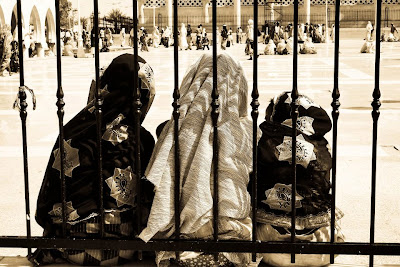
Touba is a town unlike any other that I have experienced here in Senegal. Touba is considered to be a holy city because it is the chosen residence and the sight of the interment of one of Senegal’s historical religious leaders, Cheikh Ahmadou Bamba Mbacké, alias Serigne Touba, who fathered the Muslim Mouride brotherhood. An icon in Senegal, he is revered by most as a leader who aimed to bring the Senegalese people back to the foundations of Islam during the French colonial period of the late 19th and early 20th centuries. Central to the city is the Grand Mosque—finished in 1963 and fashioned in a heliocentric pattern —which has promoted the movement of waves of settlers arriving from all regions of Senegal to inhabit this unique locale. The city is an agglomeration of several villages, which has become the second most populated region in Senegal, following Dakar; however, due to the poor infrastructure (sand-filled streets and salty water drinking water for example) and the use of ho...

A Blessed Visit from my Dear Friend, Danielle

Image
One of the greatest joys in life is a visit from an old friend. When planning my trip to Senegal, I learned that one of my dear high school friends, Danielle Mode, (http://africameetsdanielle.blogspot.com) intended to volunteer as a nurse in the course of that same period. I decided that I would not return to the States for Christmas in order to spend the holidays with one another. Arriving in the afternoon of the 28th of December, I had a packed schedule organized for her six-day vacation in Senegal. After four months of gallivanting around this lovely country, especially the Dakar environs, I have become quite familiar with its regions. With this six-day time constraint, I chose a diverse grouping of landscapes close to Pikine, Dakar: the ocean (Somone), the city (Dakar and some of its jewels), and the countryside (Taiba Ndiaye). Our adventurous spirits melded well together as we traipsed across a country I have come to cherish. The Ocean: Somone Back in October, as you might r...

Guinean Adventure

Image
I am going to start with the end of my journey, which made quite an impression on my résumé of adventures and recount in reverse. So here it goes: For those of you who were alive in the 70’s, I am sure you remember the hatchbacks of that era. Have you wondered what happened to all those vehicles once in circulation? I’m sure that some were junked, but the rest ended up in West Africa, in Guinea in particular. I had the pleasure of riding in two different bush taxis as they are called in Guinea on my way out. A testimony to the ingenuity of man, these vehicles stand the test of time and circumstances, much like the Guinean mechanics, swarthy men and tough kids. It seems as if travel by land in Guinea (and Africa in general, but to remain close to my personal account, I will be precise in saying Guinea) is indelibly memorable due to its extreme nature and harsh conditions, particularly the roads. Guinean roads are poorly if at all paved. The paved roads have so many potholes that you h...

Tam Xarit: Muslim New Year, a Veritable Couscous Dance Party

Image
I adore couscous and I love to dance in the street, but I never considered there exists an event that combines these two dissimilar items. They actually go perfectly together in the religious and deeply traditional world of Senegalese culture as the markings of the Muslim New Year celebration Tam Xarit. The Muslim calendar, which announces the dates of important religious holidays, follows the moon, comprising about 354 days per lunar calendar, whereas the western calendar—standard calendar—follows the sun. Roughly one month after Tabaski, Muslims celebrate the turning of the New Year with enormous quantities of couscous both for the household and for sharing with your neighbors and family members, and with prayer, fasting, and masquerade. As with every holiday in Senegal, there are two sides that dictate the behavior of participants: religion and tradition. In terms of its religious aspects, Tam Xarit is an opportunity for prayer and fasting for the year to come. Routine prayer c...

GRADES: Kaolack, the Land of Flies, Salty Water, and Sandy Running Paths

Image
Much awaited was my visit to Kaolack and short internship with GRADES (Group of Reflection and Action for the Development of Senegal). Before leaving for Kaolack, my family in Pikine told me three things about the city: there is a lot of theft, it’s dirty and the water is salty, and there are more flies than in Dakar. Sounds like a nice place, huh? Knowing that humans are prone to exaggeration, I had no doubt that I would find something good about this new city and region, in spite of the negative lot of characterizing details I received prior to my travels. Certainly I was right: I found many good things that I liked about Kaolack; unfortunately, so was everyone else. I traveled to Kaolack to assist GRADES in writing their Strategic Plan 2012-2016. I left Sebikotan and arrived in the city nearly four hours later when the sun was high in the sky and fiercely strong. My host told me that his wife had recently been mildly, physically assaulted and robbed by a motorcycle driver; he en...