Posts

Glimpse of Beautiful Ecuador
Image
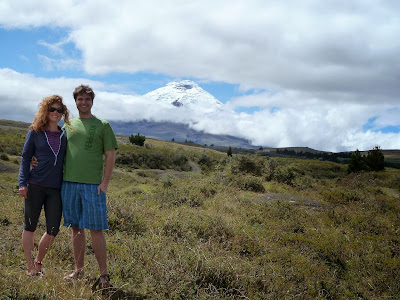
In Cotopaxi National Park --> Since arriving at the end of September, I had been almost exclusively on the farm in Ibarra, in northern Ecuador. Although I have loved being on the farm, dedicating my efforts and time to the activities of this peaceful milieu, I was happy to be able to explore some fantastic parts of Ecuador. My boyfriend, Alex, joined me for a nine-day adventure around central and eastern Ecuador. We traveled to Cotopaxi National Park, where the second highest peak in Ecuador is located, to Tena and La Selva Vida (the rainforest) and to Ba ñ os, a breath-taking area of waterfalls and green-gilded mountains. I found this snow-capped peak quite mesmerizing, as it appeared from and disappeared behind the clouds. Cotopaxi National Park is about one and a half hours from Quito, the capital, so it was our first stop. We stayed at a fabulous hostel in the middle of nowhere at 11,000 feet, where all our meals were provided. Even though we did not summit t...
Beans, Corn, Squash, Oh my!

Image
I am likely the slowest corn, bean and squash planter in the world, or in the bottom tier with the rest of my American muchachos. I need to take bean-flicking lessons. After being instructed how to take three beans and flick them into a small hole on the ground that I had just made with a spear-like tool, I went back to bending over and carefully placing the beans and corn into the hole. I tried flicking; really, I did. They went all over the ground like 52-card pick-up. I decided that bending over and proceeding with turtle speed was more efficient than trying to beat the hare to the finish line. My trench zucchini plants are growing well! I planted half an acre of one of our fields with bush beans and a quarter acre with pole beans and corn. The squash I planted along a trench that had been dug in the granadilla vineyard to allow water to flow through the land. In the field, the corn is intercropped with beans, squash and amaranth—a high-protein, gluten...

Making Organic Fertilizer

Image
The group of artisans and their families learn about making organic fertilizer. One of the main concerns of this farm is the soil. I learned back in Wisconsin that plants need potassium, phosphorus and nitrogen (K—P—N) to survive, but also they need many other different minerals and elements (e.g., calcium, zinc, magnesium, boron) and bacteria—microorganisms that contribute to the decomposition of organic matter that enriches the soil. In conventional agriculture, farmers have a plant-focused approach to growth: give the plants what is needed to grow, using chemical fertilizers that feed the plants directly but do nothing to build the soil. When the plants are ready to be harvested, the soil is as or more impoverished. On the opposite end, biological organic farming concentrates on a soil-positive approach: feed the soil and the plants will be strong and healthy. When organic plants are harvested, they leave behind soil that will continue to contribute positively...

A Song of Praise to the Garden

Image
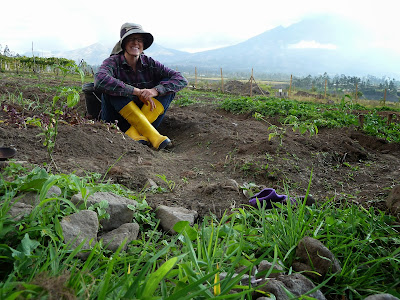
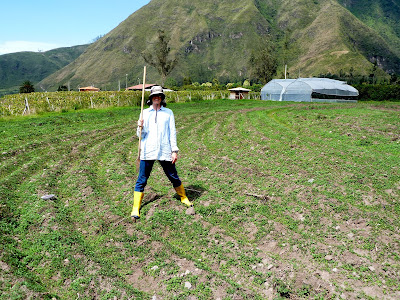
Yellow has never been my favorite color---my rain garb for working out in the garden while it pours.  How I love working in the garden! The cycle of planting and growth fascinates me. Biological farming—working with the natural ecosystem of a specific plot of land to restore or enhance its natural potential—is rewarding work. Not only does my body revel in the motion of outdoor labor, but also my spirit and mind are simultaneously at work. I bless the Creator of the environment in which my garden is situated. In turn, I am blessed by seeing the intricacies of the garden, which give, replenish and improve life.   A well tended and planted garden will hopefully yield bountiful crops. I have been soaking in all the material gleaned from the experience of those around me and from the books and articles of expert proponents on deep organic farming. Practically applying what I am theoretically learning is stimulating. I finished planting, transplanting...

Harvesting Grenadilla (Passion Fruit)

Image
  So, maybe I have missed yet another fall, my favorite season, but I have not missed out on the opportunity to harvest fruit. Although I do love apple picking in the fall, with the combination of fall odors, the cool temperatures, the turning of the leaves, the apple cider and apple pie, I do also simply enjoy the activity of plucking fruit from a tree and letting it resound with a ker-plunk in my basket. For my 27th birthday, I had my fill of harvesting fruit, from passion fruit vines. Grenadilla is so sweet and full of minerals and fiber. It is a beautifully complex fruit that looks lovely as it grows and refreshes the body as it is consumed. Inside of the grenadilla: the seeds are even edible and have a delightful crunch to them. A view of the volcano Imbabura and the grenadilla harvest Grenadilla can be harvested twice a year, and depending on the quantity of the crop, can be harvested over a period of six weeks or so. I think we will have ...

Transplanting

Image
This week I employed an age-old technique called transplanting—taking a small clump of dirt, housing a seedling of a plant or tree, and transferring it to the ground or garden. It is an effective method of giving plants a head start when the climatic elements are unfavorable (e.g., starting hot-weather plants when it is still too cold outside to plant and transplanting when the temperature warms), ensuring that only the healthy and well-formed plants are planted in the garden, or nurturing tree seedlings until they are big enough in size to survive in an outdoor, uncontrolled setting. Generally, in the case of transplanting plant seedlings, one takes the plastic potting tray of individual cups filled with dirt and the seedling (or some method where the soil remains with the seedling), remove the seedling along with the dirt, and place it carefully into a hole prepared for the transplant. The roots sometimes take time to adjust and may go into “transplant shock;”...

Beginning my Internship on Finca la Amistad

Image
Ecuador is a beautiful country, and I am blessed with the opportunity to learn more about agriculture in the majestic mountainous area of Ibarra, about two hours north of Quito. The sunsets are particularly alluring, and the weather is ideal albeit slightly chilly in the early morning and evening hours.    I hope that my one turtleneck and flannel shirt will suffice for my two months here. If not, I can always head to the market in town and buy something warm! My first week was wonderful, although my injured back keeps me from fully delving into strenuous farm work. I have tested my physical limits but the sharp pain in my side prevents me from tenaciously pursuing farm tasks, as I normally would. Hopefully I will have fully recovered by next week. I am learning to navigate the routine duties on Finca la Amistad and finding my place in the work. I think that I will be most useful helping the farm to grow vegetables in the greenhouse and in a n...